Buna-Werke sabotage and clandestine contact
The Zone of InterestBuna-Werke sabotage and clandestine contact begins when Angelus Thomsen turns his private opposition to the Nazi regime into a risky approach to Captain Roland Bullard, a British officer secretly damaging industrial equipment. The encounter joins two forms of resistance: Bullard’s physical interference with machinery and Thomsen’s offer to supply information. It also places their quiet exchange against the Buna-Werke’s visible machinery of exploitation, where civilian engineers and administrators move among injured and dead prisoners as if industrial work could continue undisturbed.
Setting and Industrial Violence
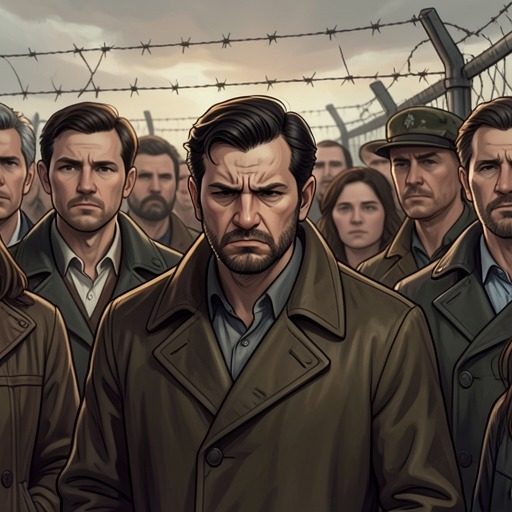
The Buna-Werke is not presented as a neutral workplace in the episode’s background. From his office window, Thomsen watches striped prisoners hurry in lines and clusters, moving at a speed their strength cannot sustain. Kapos scream at prisoners, SS noncommissioned officers scream at Kapos, and company foremen scream at the SS men. The chain of command is audible in the description, while its most revealing figures are the suited designers, engineers, and administrators from IG Farben plants in Frankfurt, Leverkusen, and Ludwigshafen. Carrying leather-bound notebooks and retractable yellow measuring tapes, they pick their way past the wounded, unconscious, and dead. Industrial administration and bodily harm occupy the same ground; the visitors’ careful measurements do not interrupt the violence around them.
The environmental damage surrounding the camp offers another measure of what that system produces. Thomsen describes water that remains undrinkable no matter how often it is boiled, with pieces beginning to ferment and the water table breached. He warns that the smell will become unbearable, and later, while driving back with benzene tanks aboard, repeatedly pulls over to smell the worsening air. These details do not establish that the sabotage causes or remedies the contamination. Instead, they place the clandestine contact inside a landscape whose pollution and stench reach beyond any single machine or workplace. The technical order of the Buna-Werke coexists with a material disorder that its officials cannot make disappear.
Thomsen Approaches Bullard
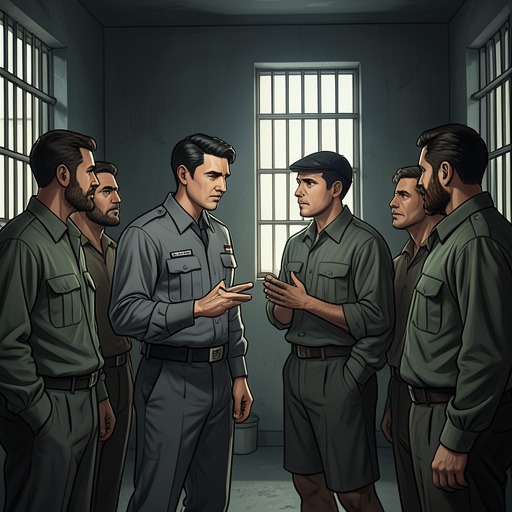
The decisive encounter takes place on the last day of November. Thomsen has been watching Bullard and follows him into a tool cabin between the Stalags. There, Bullard has laid the components of a dismantled welding gun on a pillowslip. Thomsen’s approach is deliberate: he has waited, watched, and chosen a moment when Bullard is alone with the evidence of his clandestine activity. The improvised setting, and the dismantled equipment spread out before them, make the conversation a meeting between people who cannot safely announce their purposes in the open.
Thomsen begins with an oblique offer involving “Players,” “Senior Services,” and Woodbines. Bullard responds appreciatively to the cigarettes. The exchange does not explain every phrase or spell out a complete communications protocol; its importance lies in how cautiously the two men establish mutual recognition. Thomsen then invokes Rule Britannia, reciting its language of freedom and resistance to tyrants. Bullard studies him before answering in the same register. The song functions not simply as patriotic reference but as a test: Thomsen signals that he has chosen a side, and Bullard has to decide whether the signal can be trusted.
Thomsen makes clear that he has been observing Bullard. He tells him he saw him bending the blades of a cooling fan in the Polimerisations-Buro and says he liked what he saw. This is the concrete act that turns their encounter from a tentative conversation into contact between men who recognize sabotage. Bullard’s surprised response gives way to a direct question about whether there are others like him. Bullard answers, “There are. Twelve hundred others.” The number abruptly enlarges the scale of what Thomsen has encountered: the activity is not presented as the solitary gesture of one officer but as part of a much wider clandestine presence.
An Exchange of Allegiance and Information
Thomsen explains his position in blunt political terms. He is fed up with the Third Reich and its claim to last a thousand years; the men’s exchange of a mocking future date makes that promised permanence sound absurd. The exchange does not amount to a detailed discussion of their political beliefs or operational plan. It does establish that Thomsen is not approaching Bullard as a neutral observer: he wants the regime gone and is willing to act against it.
The practical offer follows. Thomsen asks whether Bullard needs information and says he can help. Bullard’s answer is affirmative. The scene therefore defines their contact as potentially reciprocal: Bullard’s side is already damaging equipment, while Thomsen can contribute information. The passage does not specify what information will be passed, how it will be transmitted, or what later operations result from the agreement. Its immediate consequence is more limited and more consequential than a general declaration: the two men have recognized one another as collaborators, and Bullard accepts Thomsen’s offer.
Their final exchange returns to Rule Britannia. Bullard lights a Woodbine and recites another passage from the song before telling Thomsen that they understand one another. That answer closes the scene on recognition rather than on a documented act of sabotage or a completed exchange of intelligence. The cigarettes, the song, and the covered dismantled weapon have each helped make the contact possible, but the text keeps the operational details beyond the scene’s boundary.
Resistance Against the Language of Obedience
The episode’s opposition to the regime is sharpened by the book’s recurring contrast between declared ideals and material consequences. In a separate reflection on the camp, Paul Doll asks why its activities smell so foul, why people drink so brutally, why the meadow churns, and why the snow turns brown. He connects the camp’s obedience to the word Kadavergehorsam, whose corpse-bearing meaning makes dutiful submission sound inseparable from death. That reflection is not part of Thomsen and Bullard’s conversation, but it clarifies the world in which their defiance takes shape: the supposedly orderly system is surrounded by contamination, corpses, and the damage it produces.
Thomsen and Bullard’s exchange reverses the regime’s language of permanence and submission without pretending that a song or a secret meeting can undo the violence around them. Rule Britannia gives them a shared vocabulary of resistance; the bent fan blades and dismantled welding gun give that vocabulary a material counterpart. The encounter records the beginning of a clandestine connection, not its final outcome. Its force lies in the moment when observation becomes an offer, the offer is accepted, and resistance at the Buna-Werke acquires a new point of contact.